How Does Art Spiegelman Discuss Historical Accuracy in Maus
Due east arly in the second volume of Maus – the graphic novel about the Holocaust that fabricated Art Spiegelman'south reputation – he includes a passage showing the reaction to the publication of volume one. The artist is sitting at his drawing board, perched atop a mountain of dead bodies, as a succession of importunate reporters crowd in bombarding him with questions: "Okay... permit's talk about Israel..." "Could you tell your audition if drawing Maus was cathartic? Do you feel better now?"
As the questions come in, he struggles to answer – "A message? I dunno..." "Who am I to say?" – and over the form of the post-obit panels shrinks to the size of a toddler, marooned in his writing chair. "I want... ABSOLUTION. No... No... I want... I want... my MOMMY! WAH!" The reporters vanish, and mini-Spiegelman confesses: "Sometimes I just don't experience like a functioning developed."
Yet being adult is, in a way, what Spiegelman is famous for. In the age-one-time give-and-take about when comics finally "grew up" Maus is often showroom A. The New Yorker called information technology "the first masterpiece in comic-volume history". It's the comic that people who don't read comics have read, and the only graphic novel ever to take won a Pulitzer prize. 40 years on – the starting time chapter appeared in series form in Spiegelman's underground zine Raw in December 1980 – information technology remains a monument in the genre.
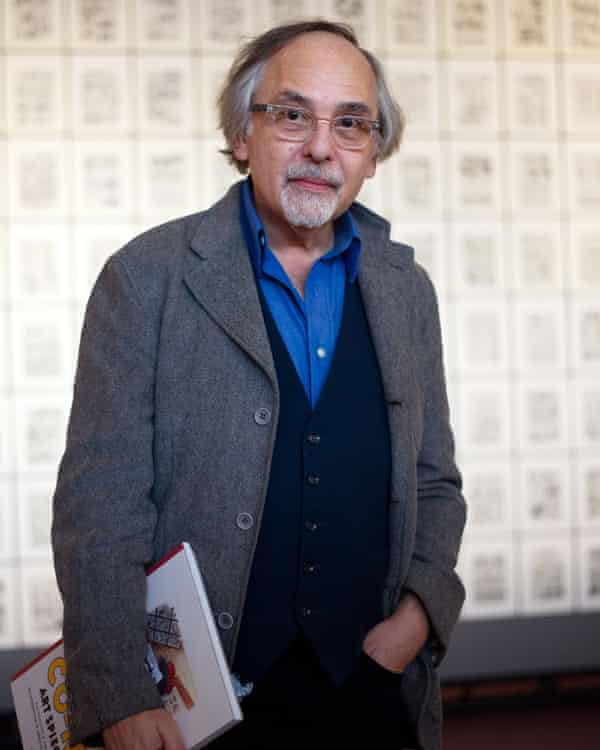
I talk to Spiegelman over Zoom from his New York flat. Wearing a stake fedora and tinted glasses indoors and choffing on a vape, he's fidgety and garrulous and emphatic. Only when I mention the anniversary he's vague. "In that location seems to exist another anniversary available from anything to anything if one only finds the right two events."
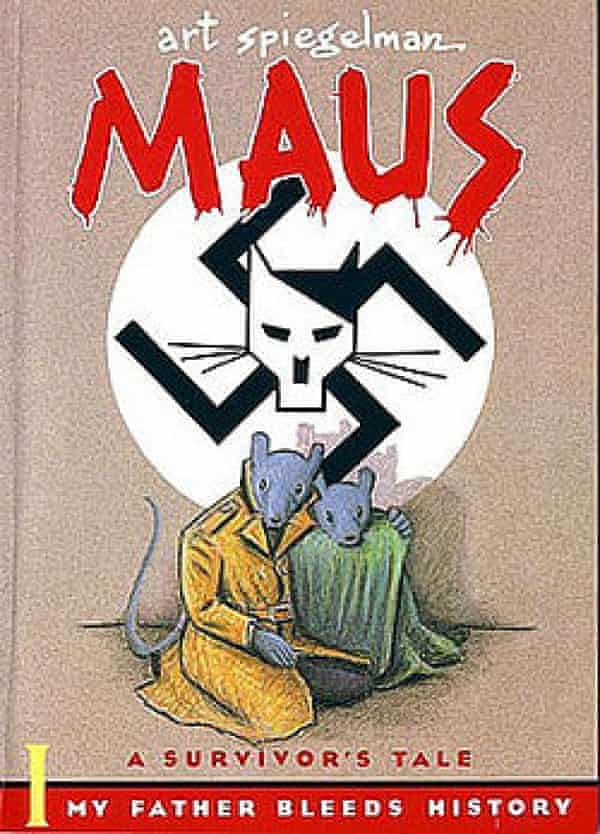
Its creator may be vague, but Maus is precise. It'due south a complex and subtle slice of piece of work: partly a family memoir, partly an human action of historical documentation and (equally the passage I draw higher up makes clear), partly a self-reflective account of its own cosmos. The frame story, prepare in late 1970s New York, shows the grown-upward Spiegelman's human relationship with his grouchy and eccentric elderly father Vladek, and his attempts to interview him almost his early life. Threaded through this is the account that emerges of Vladek's human relationship with Spiegelman'southward mother (who took her own life in 1968, when Art was merely emerging from his teens), the Nazis' rise to power, and the route to Auschwitz.
It's a paradoxical mixture of apparent extravaganza and extreme fidelity to the truth. In the historical sections Germans are drawn as human-bodied cats, and Jews as mice, and in some of the present-day story the protagonists wear mouse masks. Yet their diction – the cadences of his Polish-born father's English, his kvetching and kibitzing – is impeccably rendered, and Spiegelman worked similar crazy to verify the historical particular, downwardly to the wait of the machinery in the tin-shop in which his father worked.
At one betoken in the book, Spiegelman is in despair: "I feel so inadequate," he tells his married woman, "trying to reconstruct a reality that was worse than my darkest dreams. And trying to do it as a comic strip! I guess I bit off more I can chew." He didn't, obviously: merely it'southward surprising that a lifelong champion of the comic strip equally an expressive medium seemed to be saying at that place that some subjects might exist out of its reach.
"I didn't hateful comics," he says now. "I meant art or literature. I didn't feel it was possible to give structure to this that would exist meaningful. I didn't know how to proceed in making it in comics form, because there wasn't much of a model for making something similar it. But I call back if I had somehow gone down one of those string theory universes next door where I became a writer, I would have the same misgivings."
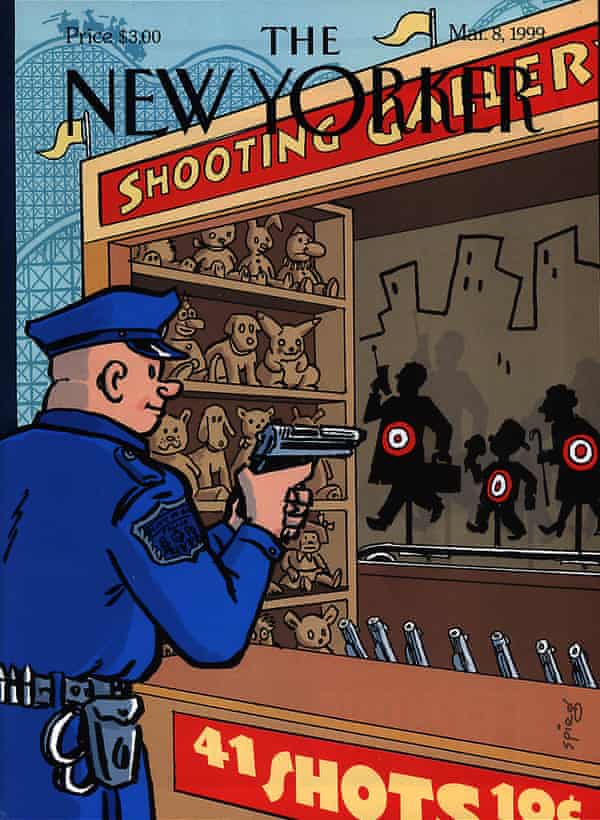
Spiegelman'due south success had the disconcerting effect of placing an artist who had been happy in the comix-with-an-10 underground – a lysergic disciple of R Crumb – very firmly in the literary establishment. He became a staple of Tina Brown's New Yorker, a darling of academics, and came to exist regarded by many, not without resentment, as a sort of capo of the U.s. comics scene.
"I retrieve when I first got this Pulitzer prize I thought it was a prank call," he says, "Merely immediately after I got back to New York, I got an urgent phone call from a wonderful cartoonist and friend, Jules Feiffer: 'We have to run across immediately. Can you come up out and have a coffee?' And we met. He said: 'Y'all have to understand what you've merely got. It'south either a licence to kill, or something that will kill you.'"
That comics are now considered "respectable" – thanks in office to Maus – is something Spiegelman never quite looked for. But he acknowledges it has its advantages. "I'm astounded by how things have changed. And I would say I might take been dishonest or disingenuous when I said I wasn't interested in it beingness respectable. I dear the medium. And I love what was done in it from the 19th century to at present. But I know that on some level, I want it to be able to not have to brand everything have a joke, or an escapist risk story."
His rocket launch into canonicity was both "liberating and as well incredibly confining – trying to find places to go where I wouldn't have to be the Elie Wiesel of comic books". Fifty-fifty at the time, Spiegelman seems to have been witting that Maus would be in danger of defining him. The next project he took on was illustrating Moncure March's jazz-age verse form The Wild Party for a small press: "This was going to be a kind of polar opposite [to Maus]: decorative, erotic, frivolous in many means and involved with the pleasures of making; although it didn't plow out to be so pleasurable in its third year. Every project I outset turns into a bury."
And still, what coffins. Spiegelman'southward attention to his craft, to the grammar of comics and their narrative possibilities, is formidable. It seems quite in keeping that an apparently elementary analogy project turned into a three-twelvemonth job. Maus took more than than a decade to consummate – "I always assumed information technology would take near two years" – and in conversation he will zero in on the tiniest details in private panels from retentiveness. There'southward a single transition panel, for instance, where a railroad train ticket goes in as the explanation, that he identifies as having been drawn under the influence of Will Eisner'southward The Spirit.
In an afterword to Breakdowns, an anthology of his earlier work, Spiegelman writes of his younger self: "In an cloak-and-dagger comix scene that prided itself on breaking taboos, he was breaking the 1 taboo left standing: he dared to call himself an creative person and telephone call his medium an fine art-form." Merely that aspiration doesn't marker a straightforward high culture/low culture split.
"Lower heart grade to middle course in terms of my upbringing," Spiegelman says, "I was very suspicious of high culture and kind of described myself as a slob snob. If it wasn't printed on newsprint, the hell with information technology. If I was learning nearly modernism, it was more likely to be from Winsor McCay and George Herriman than from Picasso. I was resistant. I read Kafka [and idea] he would have been a expert script writer for The Twilight Zone. I was seeing information technology as a zone of culture that wasn't exactly high or depression, that just had to do with culture I could use."
A thunderbolt moment was his discovery of Harvey Kurtzman and Mad magazine: "That was what changed my life," he says. "I guess Mad came out as the lowest of depression culture, merely it really has become our culture. The irony, the self-reflexivity, the questioning, the parodic enveloping of everything seen through that lens." The recent demise of the print magazine was, he says, "mission accomplished. You know, there wasn't much more it could do."
And he is startlingly protean as a creator. A panel of Chris Ware or Daniel Clowes, Herriman, Neb Sienkiewicz or Jack Kirby is instantly identifiable as such. Merely you'd struggle to wait at the urbane images for The Wild Party, or his psychedelic early piece of work at Raw, or the cross-cut of styles in In the Shadow of No Towers, and instantly clock them every bit the piece of work of the author of Maus. And he however has people approaching him in astonishment to detect he was likewise the creator of The Garbage Pail Kids, the trading cards of 1980s playground fame. "It's kind of dissonant for people," he says. He is, every bit was said of the late Clive James, "a brilliant bunch of guys".
"That's nice phrasing," he says. "I took to heart a quote from Picasso: 'Fashion is the difference between a circle and the way you draw it.' I would like to think of myself as just using any manner seems appropriate to the work, and the style is as much finding out what the work is as the piece of work itself. Everything I've done comes later on a lot of stylistic inquiry. And the main thing that makes it my style is I but describe badly." That's not wholly cocky-deprecation. When he'due south tried writing for others to depict, he says, "I would discover that other people couldn't depict it wrong the right mode."
Incorporated into Maus is a total reprint of his short strip "Prisoner on the Hell Planet", which describes his nervous breakdown in the aftermath of his mother's suicide in a vividly expressionist idiom (and which portrayed Spiegelman wearing the striped pyjamas and striped cap of an Auschwitz inmate). Ane reason he did that, he says, is that the fact of his own breakdown "needed to be entered into the deposition", but the other was something necessary "formally – which was to show that the drawing manner in Maus was a decision".
His one major foray into cartooning the political moment also had a desperate stylistic effect. In the Shadow of No Towers charted his response to ix/11, and found him out of kilter not only with his countrymen (David Remnick's New Yorker declined to publish a comic whose author was "equally terrorised by al-Qaida and my regime") but with himself. "I think Towers came close to the any-port-in-a-storm kind of driving through a hurricane," he says. "The styles shifted from sequence to sequence and panel to console. And that felt very right for trying to bargain with the fragmentation that 9/xi caused for me. And I call back that'south kind of where I'm at at present."
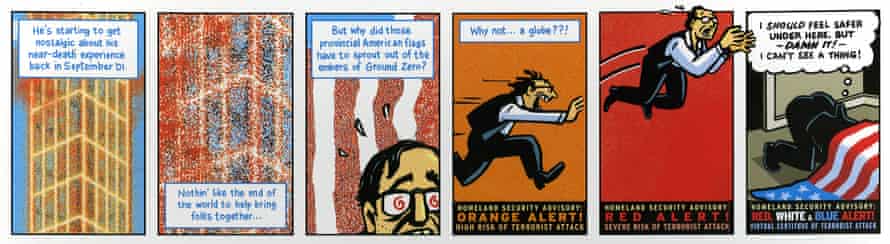
Indeed, he delayed this interview for several weeks as he attempted to process the summertime's chaos. "I am actually trying to empathize what the fuck?" he says. "The world was never a bed of roses, only at this point, every fourth dimension I look upwards, it's like … oh, man, you lot know? I feel like if I had a tattoo – which I'll never get voluntarily – information technology would be on my chest. It would say: 'You can't make this shit up', and it would glow brilliant cerise well-nigh 5 times a mean solar day." Only he says he has no impulse to respond to America'south current turmoil in art.
"Early on on I realised I didn't desire to get a Trump caricaturist – that it was only playing into his narcissism, ultimately. I just backed off and I'm now trying to see what the hell's been happening to united states of america. It makes me recant something I rather cockily said back in 2001, which was when I found myself unable to move from September 11 to September 12. Well-nigh three months later, my brains poured back in my head and I said: 'I estimate disaster is my muse.'" He recants: "Now disaster is just a fucking disaster."
And in a sense, that was the theme of Maus – among whose many scrupulousnesses was a true-blue rendition of the extremely hard and annoying personality of Vladek. "I thought it was important to prove that there's nothing ennobling about being victimised," Spiegelman says. "That's a very Christian concept. Only people don't come up out of it as better humans: they merely come out of information technology seared, scarred. She came out with so much wisdom, or he came out as stupid as he went in, he came out fifty-fifty more traumatised and befuddled than when he went in. It's a spectrum. But what it is, is: information technology wasn't the best who survived, and information technology wasn't the worst. It was random."
-
In the Shadow of No Towers by Art Spiegelman (Penguin Books, £40). To lodge a copy go to guardianbookshop.com. Delivery charges may apply.
Source: https://www.theguardian.com/books/2020/oct/17/graphic-artist-art-spiegelman-on-maus-politics-and-drawing-badly
0 Response to "How Does Art Spiegelman Discuss Historical Accuracy in Maus"
Postar um comentário