Is Uniformly Continuous on 0 ˆž Chegg
Uniformly continuous function $\rightarrow 0$ as $x\rightarrow\infty$
Solution 1
Suppose that $f(x) \not \to 0$ as $x \to \infty$. This means that: $$ \exists \epsilon > 0 : \forall M > 0, \exists x > M : x > M \implies \left|f(x)\right| > \epsilon $$
Since $f$ is uniformly continuous, for this $\epsilon$ there is $\delta > 0$ satisfying: $$ \forall x, y > 0 : |x - y| < \delta \implies \left|f(x) - f(y)\right| < \epsilon/2 $$
Putting the two together, we find that: $$ \forall M > 0 : \exists x > M : y \in (x -\delta, x +\delta) \implies f(y) > \epsilon /2 $$
Thus: $$ \int_{x-\delta}^{x+\delta} \left|f(y)\right| \,dy \ge \dfrac{\delta \epsilon}{2} $$
This process can be repeated as many times as we like. We start by finding $x_0 > 1$. Next, we find $x_1 > x_0 + 2\delta$. And we continue by finding $x_n > x_{n-1} + 2\delta$. None of the intervals $(x_n - \delta, x_n + \delta)$ overlap. Thus: $$ \int_0^\infty \left|f(y)\right| \,dy \ge \dfrac{\delta \epsilon n}{2} \quad \forall n \in \mathbb{N}, n > 0 $$
We conclude that $f$ is not Lebesgue integrable.
Solution 2
Expanding my comment into an answer, since the ones at the duplicate I found are comparatively hard to read.
Since $f$ can be rewritten as the difference of two nonnegative uniformly continuous functions, we can proceed by showing this holds for such functions $f\geq 0$.
The definition of uniform continuity says that for any $\epsilon>0$, there exists $\delta>0$ such that the entire graph can be covered with rectangles of width $2\delta$ and height $2\epsilon$, placed end to end.
Suppose $f(x)$ did not converge to zero on the right. Then there exists a $k>0$ such that $f(x)$ jumps above $k$ infinitely many times. Set $\epsilon=k/4$ and find the associated $\delta$. By this choice of $\epsilon$, there will always be a box of width $2\delta$ and height at least $k/2$ fully under the curve at each point where $f(x)$ goes above $k$.
Such boxes have area at least $\delta k$, and since there are infintely many of them under the curve, this would contradict Lebesgue integrability. Hence, $f$ tends to zero on the right.
Related videos on Youtube

01 : 39
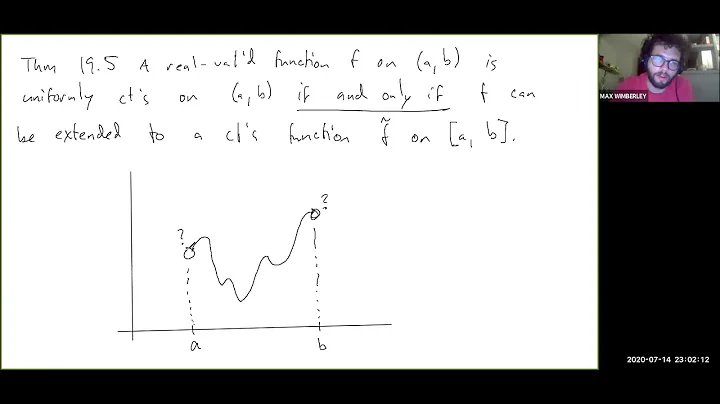
f(X):=1/X is uniformly continuous on [a, infinity)
15 : 18
Lecture 13.7 - Extending Uniformly Continuous Functions

14 : 17
Real Analysis | The uniform continuity of sqrt(x).

14 : 56
#07 prove that f(x)=1/x^2 is uniform contiouous on [a ,infinite) but not UC on (0, infinite)

10 : 45
#02 Prove that (x)^1/2 is uniform continuous on [0,infinite) | prove that square root of x is UC
Comments
-
-
Basically, the idea is this. Let $\epsilon>0$. Then there exists a $\delta>0$ such that the entire graph of $f$ can be covered by squares $2\delta$ long and $2\epsilon$ high, touching edge to edge. If $f$ did not converge to zero, then there would have to exist infinitely many "bumps" that reach a certain height, and if you choose $\epsilon$ small enough, there will be space left between the box and $x=0$. This little space occurring infinitely many times would contradict the integrability of $f$.
-
Prove that if $f$ is uniformly continuous and $f(x)\nrightarrow 0$ as $x\to \infty$, then $f$ is not lebesgue integrable.
-
I recommend that you try to construct a function which is continuous, but not uniformly continuous, integrable and $f(x) \nrightarrow 0$ for $x \to \infty$. The answers contain some hints for this.
-
$f(x)=x^2$ works....?
-
That's not integrable.
-
Recents
What is the matrix and directed graph corresponding to the relation $\{(1, 1), (2, 2), (3, 3), (4, 4), (4, 3), (4, 1), (3, 2), (3, 1)\}$?
Source: https://9to5science.com/uniformly-continuous-function-rightarrow-0-as-x-rightarrow-infty
0 Response to "Is Uniformly Continuous on 0 ˆž Chegg"
Postar um comentário